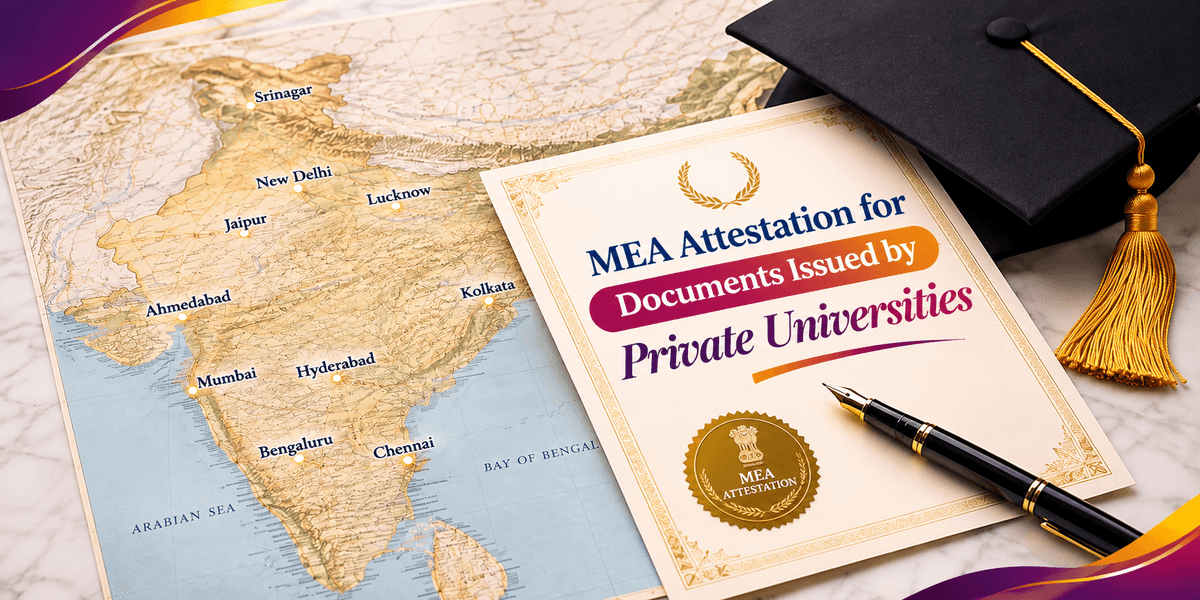
MEA Attestation for Private University Documents – Complete Guide
Private universities play an important role in India's higher education system. They offer undergraduate, postgraduate, doctoral, professional and specialised programmes across disciplines such as engineering, management, medicine-related fields, law, science, commerce, humanities and information technology. Graduates from these institutions increasingly pursue employment, higher education, professional registration and business opportunities overseas.
When an Indian degree or academic certificate is submitted to a foreign employer, university, government department or immigration authority, the receiving organisation may require document authentication. Depending on the destination country and purpose, this can involve verification by the issuing university, authentication by the relevant State Government authority, Ministry of External Affairs (MEA) attestation or apostille, and sometimes further embassy or consular legalization.
A common question among graduates is whether documents issued by private universities are eligible for MEA attestation. The answer is that the fact that a university is privately managed does not, by itself, make its certificates ineligible for MEA attestation. What matters is whether the university and qualification are legally recognized, whether the document can be authenticated through the applicable process, and whether the required preliminary verification is completed.
However, the process is not identical for every private university or every document. A degree from a recognized private university, a provisional certificate, a consolidated marksheet and a transcript may follow different verification arrangements. The relevant State Government authority may also have specific requirements before the document can be submitted for MEA authentication.
This guide explains the complete process of MEA attestation for documents issued by private universities in India. It covers eligibility, university recognition, HRD or State Education Department authentication, MEA apostille, embassy attestation, required documents, fees, timelines, common rejection reasons and practical steps for applicants.
Whether you are planning to work in the UAE, Qatar, Kuwait, Saudi Arabia, Oman, Bahrain, Malaysia, Singapore, Europe, Australia or another destination, understanding the authentication process can help you prepare your educational documents correctly.
1. What Is MEA Attestation for Private University Documents?
MEA attestation is the authentication of an Indian document by the Ministry of External Affairs, Government of India. It confirms the authenticity of the signature, seal or official capacity of the designated authority whose signature appears on the document.
For educational certificates issued by private universities, MEA attestation generally comes after the required preliminary authentication or verification by the competent State Government authority, as applicable.
The MEA does not independently assess the academic quality of a university, verify the student's marks or certify that a degree is equivalent to a foreign qualification. Its role in the document authentication chain is to authenticate the signature or seal of the designated authority.
This distinction is important. A certificate may be academically valid, but it still needs to pass the prescribed authentication process before it can receive an MEA apostille or attestation.
What does MEA attestation establish?
MEA attestation establishes that the signature or official seal being authenticated is genuine within the applicable authentication process. It supports the receiving authority's assessment of the document's origin.
It does not automatically establish:
- That the qualification is equivalent to a degree in another country.
- That the university's programme is accepted by every foreign employer.
- That the applicant is eligible for a particular job or professional license.
- That the marks, grades or academic claims have been independently evaluated by MEA.
- That the document will be accepted for every immigration, admission or employment purpose.
The receiving country or institution may still conduct its own academic equivalency assessment, verification or professional licensing procedure.
2. Are Private University Degrees Eligible for MEA Attestation?
Yes. Documents issued by eligible and recognized private universities can be considered for MEA attestation, subject to the applicable verification and authentication requirements.
India has both public and private universities. Private universities are established under the relevant legislation and operate within the applicable higher education regulatory framework. Their legal status and the recognition of their programmes are important considerations when documents are presented for official authentication.
Applicants should not assume that a private university certificate is automatically unacceptable simply because the institution is privately managed.
At the same time, not every institution that uses the words university, institute, academy or college in its name has the legal status of a recognized university. The institution's legal recognition and authority to award the particular qualification should be checked before beginning the attestation process.
Important eligibility considerations
Before submitting a private university certificate for attestation, check the following:
1. Legal status of the university
Confirm that the institution is legally established and recognized under the applicable Indian higher education framework. The University Grants Commission (UGC) is an important source for checking the status of universities in India.
2. Recognition during the relevant academic period
Check whether the university was legally entitled to award the qualification during the period in which the student studied and graduated. Current recognition alone may not resolve questions relating to an earlier academic period.
3. Authority to award the qualification
Confirm that the institution was authorized to award the specific degree or qualification. A certificate issued by an affiliated college, study centre, franchise or training provider may require a different assessment from a degree issued directly by the university.
4. Programme-specific requirements
Some programmes may be subject to additional regulatory requirements. Applicants should check the relevant professional or statutory regulator where applicable.
5. Authenticity of the certificate
The university must be able to verify the certificate, registration details, student records and authorized signatory information through its prescribed process.
6. State-level authentication requirements
The competent State Government authority may require verification from the issuing university before authenticating an educational document for onward MEA submission.
The exact process can vary according to the university, State Government arrangements, document type and current MEA submission procedure.
3. Why Do Private University Documents Need MEA Attestation?
A degree or academic certificate issued in India may not be accepted overseas in its original form for every official purpose. Foreign authorities often require authentication to establish that the document originates from a legitimate issuing institution and has passed the prescribed government authentication process.
MEA attestation is commonly required when Indian educational documents are used for:
Overseas employment
Employers in several countries request attested degree certificates, diplomas or marksheets during recruitment and onboarding. This is particularly common in sectors such as engineering, healthcare, education, construction, finance, management and information technology.
Higher education abroad
Foreign universities may request authenticated degree certificates and transcripts when applicants seek admission to postgraduate programmes, doctoral research or professional courses.
Employment visa applications
Some visa categories and destination-country procedures require educational documents to be attested or legalized before they can be used as supporting evidence.
Professional licensing
Applicants seeking registration with a foreign professional authority may need authenticated educational documents. Additional academic evaluation or professional verification may also be necessary.
Immigration and residency procedures
Certain immigration or residency applications require educational documents as part of the supporting documentation. The exact requirements depend on the destination country's rules.
Government and institutional submissions
Foreign government departments, educational institutions and other official organisations may request authenticated certificates to establish their origin.
Important: MEA attestation is not a universal requirement for every foreign application. Applicants should first confirm whether the receiving authority requires an apostille, normal attestation, embassy legalization or another form of verification.
4. Documents Issued by Private Universities That May Require Attestation
Private universities issue several types of academic documents. The document required for authentication depends on the purpose for which it will be used.
The most common categories include:
Degree certificates
A degree certificate is issued after the successful completion of an academic programme. It is one of the most frequently requested documents for overseas employment and higher education.
Examples include:
- Bachelor of Engineering (BE)
- Bachelor of Technology (BTech)
- Bachelor of Commerce (BCom)
- Bachelor of Business Administration (BBA)
- Bachelor of Arts (BA)
- Bachelor of Science (BSc)
- Master of Business Administration (MBA)
- Master of Technology (MTech)
- Master of Science (MSc)
- Master of Commerce (MCom)
- Master of Arts (MA)
- Doctor of Philosophy (PhD)
Provisional degree certificates
A provisional degree certificate may be issued after a student completes the academic requirements but before the final degree certificate is formally issued.
Some foreign employers or institutions accept provisional certificates, while others specifically require the final degree. Applicants should confirm the receiving authority's requirements before beginning the attestation process.
Consolidated marksheets
A consolidated marksheet provides an overall record of a student's academic performance across semesters or years. It may be required for employment, admissions or professional assessment.
Individual semester marksheets
Some authorities require individual semester-wise marksheets instead of, or in addition to, a consolidated marksheet.
Academic transcripts
Transcripts provide details of subjects, grades, credits, marks and other academic information. Universities generally issue official transcripts according to their own procedures.
Diploma and postgraduate diploma certificates
Diploma and postgraduate diploma documents may also require authentication, depending on the qualification, issuing institution and destination-country requirements.
Bonafide and study certificates
A bonafide certificate or study certificate confirms a student's enrolment or period of study. These documents may be required for specific overseas applications, but their authentication route should be checked individually.
Other academic documents
Additional documents may include:
- Course completion certificates.
- Internship or practical training certificates.
- Research-related certificates.
- Medium of instruction certificates.
- Migration certificates.
- Transfer certificates.
- Registration or enrolment certificates.
Not every document in this list is necessarily eligible for the same authentication route. The competent authority and MEA submission requirements should be confirmed before applying.
5. The Difference Between University Verification, HRD Attestation and MEA Attestation
One of the most common sources of confusion for private university graduates is the difference between university verification, State Education Department or HRD authentication, and MEA attestation.
These are separate stages with different responsibilities.
University verification
University verification is the process through which the issuing institution confirms that the academic document is genuine and corresponds to its official student records.
The university may check:
- Student registration number.
- Course and programme details.
- Admission and completion records.
- Examination results.
- Degree award information.
- Certificate number.
- Authorized signatory details.
Some universities provide online verification, while others require a formal application, physical document submission, transcript request or direct institutional communication.
State Education Department or HRD authentication
Educational documents are generally required to undergo preliminary authentication by the designated Education Department of the concerned State or Union Territory for the applicable MEA process.
The term HRD attestation is commonly used to describe this state-level authentication of educational documents. However, the official department name, designated authority and procedure can differ between states.
The competent authority may verify the document or rely on verification from the issuing university before authenticating the relevant signature or seal.
MEA attestation
After the required preliminary authentication, the document can proceed through the applicable MEA process.
MEA authenticates the signature or seal of the designated State Government authority or other competent authority in the prescribed authentication chain.
Why these stages matter
A university's confirmation of a certificate does not automatically replace the State Government authentication required for the applicable MEA route. Similarly, a university's verification stamp is not the same as an MEA apostille.
Applicants should identify each stage separately and avoid treating the terms university verification, HRD attestation, MEA attestation and apostille as interchangeable.
6. Step-by-Step Process for MEA Attestation of Private University Documents
The process of MEA attestation for a private university certificate generally involves multiple stages. The exact sequence and documentation requirements should be confirmed for the issuing university and the State Government authority concerned.
Step 1: Identify the document and its intended use
Start by identifying the exact academic document that needs authentication.
For example:
- Is it a final degree certificate?
- Is it a provisional certificate?
- Is it a consolidated marksheet?
- Does the receiving authority require individual semester marksheets?
- Is the document required for employment, higher education or professional licensing?
The intended destination country is equally important because it determines whether the applicant needs an apostille or normal attestation followed by embassy or consular legalization.
Step 2: Check the university's legal recognition
Confirm that the private university has the required legal status and authority to award the qualification.
Check the university's details against official higher education information, including applicable UGC records. Where relevant, confirm programme-specific recognition or regulatory approval.
Do not rely exclusively on the university's website, marketing material or an agent's verbal assurance.
Step 3: Obtain university verification if required
Contact the university's examination, registrar or certificate verification department.
Ask whether the certificate must be verified directly by the university before State Government authentication.
Depending on the institution, the applicant may need to submit:
- Original degree certificate.
- Original marksheets.
- Student identification details.
- Registration number.
- Application form.
- Identity proof.
- University verification fee, where applicable.
Some universities may communicate verification directly to the designated authority. Others may provide an official verification letter or sealed confirmation.
Follow the university's prescribed procedure rather than relying on an informal stamp or an unofficial intermediary.
Step 4: Complete State Government authentication
For educational documents, the applicable MEA process generally requires preliminary authentication by the designated Education Department of the concerned State or Union Territory.
The procedure depends on the State Government's current arrangements and the document concerned.
The authority may require:
- Original certificate.
- University verification.
- Marksheets or supporting academic records.
- Student identity proof.
- Application form.
- Additional institutional confirmation.
The relevant State Government authority may verify the university's signature, the certificate's origin or other details required under its process.
For private universities, it is especially important to confirm that the competent state authority accepts documents issued by that institution and understands the appropriate verification route.
Step 5: Prepare the document for MEA submission
Once the required preliminary authentication is complete, prepare the document for the applicable MEA process.
Check:
- Whether the original certificate is required.
- Whether the state-level authentication is complete.
- Whether the document is in an acceptable physical or digital format.
- Whether supporting identity documents are required.
- Whether the destination country requires apostille or normal attestation.
- Whether the submission must be made through an authorized outsourced service provider or an eligible digital process.
Do not laminate, alter, overwrite or otherwise modify a certificate in a way that may affect its examination.
Step 6: Submit through the applicable MEA channel
The MEA's document attestation and apostille services operate through the prescribed submission arrangements. Depending on the service and eligibility, applicants may use designated outsourced service providers or the e-Sanad platform.
The correct channel depends on the document, its authentication history and the availability of the relevant digital record.
For physical submissions, follow the current instructions regarding document packaging, application forms, supporting papers, collection and delivery.
Step 7: MEA authentication or apostille
After the document is accepted and the required checks are completed, MEA applies the relevant authentication.
For an apostille, the document receives an apostille certificate or sticker in the prescribed format.
For normal attestation, the document receives the relevant MEA authentication.
These are not interchangeable services. The correct one depends on the destination country and the receiving authority's requirements.
Step 8: Complete further legalization if required
Some destinations require additional embassy or consular legalization after MEA attestation.
For example, a document intended for use in a country that does not accept the Hague Apostille route for the particular application may require normal MEA attestation followed by the relevant embassy or consular process.
Some countries may also require authentication by a foreign ministry or another local authority after the document reaches the destination country.
Always confirm the full chain before submitting the certificate.
7. MEA Apostille vs Normal Attestation for Private University Degrees
MEA provides different authentication services depending on the destination country and the applicable international arrangement.
Understanding the difference between apostille and normal attestation helps applicants avoid unnecessary procedures.
What is MEA apostille?
An apostille is a standardized certificate used under the Hague Apostille Convention to authenticate the origin of a public document for use in another country where the Convention applies between the relevant states.
For an eligible Indian educational document, the prescribed authentication process is completed before MEA issues the apostille.
The apostille verifies the authenticity of the signature, the capacity in which the person signing the document acted and, where applicable, the identity of the seal or stamp.
It does not verify the academic content or guarantee acceptance of the qualification.
What is normal MEA attestation?
Normal MEA attestation is used when the document must follow the traditional legalization route rather than the apostille route.
After MEA authentication, the document may need to be submitted to the embassy, consulate or other competent authority of the destination country.
Key differences
| Feature | MEA Apostille | Normal MEA Attestation |
|---|---|---|
| Main purpose | Authentication for use under the Hague Apostille system | Authentication for the traditional legalization process |
| International framework | Hague Apostille Convention | Destination-country legalization requirements |
| MEA action | Issues apostille | Applies normal attestation |
| Embassy legalization | Generally not required where apostille is accepted for the relevant use | May be required |
| Final acceptance | Subject to receiving authority's requirements | Subject to receiving authority's requirements |
Which one should a private university graduate choose?
The answer depends on the destination country, the relevant international arrangements and the purpose of submission.
Before choosing a service, confirm:
Whether the destination country is a party to the Hague Apostille Convention.
Whether the Convention is in force between India and that destination country.
Whether any relevant objection or territorial declaration affects the relationship.
Whether the receiving authority accepts apostilled educational documents for the intended purpose.
Whether additional legalization or translation is required.
A country being listed as a Convention member does not automatically mean that every document or application is exempt from all further requirements.
8. Requirements for MEA Attestation of Private University Certificates
The required documents can differ according to the university, State Government authority, document type and MEA submission channel.
Applicants should prepare the following as a starting point.
Primary educational document
This is the original degree certificate, provisional certificate, marksheet or other academic document requiring authentication.
University verification
Where required, obtain verification or confirmation from the issuing university through its official procedure.
Academic supporting documents
Depending on the case, the authority may request:
- Consolidated marksheet.
- Individual semester marksheets.
- Course completion certificate.
- Transcript.
- Admission or registration details.
- University-issued verification letter.
Identity proof
A valid identity document may be required to establish the applicant's identity.
Examples include:
- Passport.
- Aadhaar card.
- Other accepted government-issued identity proof.
The exact accepted identity documents depend on the submission channel.
Passport copy
A passport copy may be requested to establish the applicant's identity and intended overseas use. Ensure that the details are clear and consistent.
Application form
Complete the relevant application form accurately. The name, certificate details and contact information should match the supporting records.
Authorization letter
If an authorized representative is submitting or collecting documents on the applicant's behalf, an authorization letter and identity proof may be required under the applicable process.
Destination-country information
Keep details of the destination country and the receiving organization available. These details help determine the correct authentication route.
Practical recommendation: Do not assume that every document listed above is compulsory in every case. Confirm the current checklist with the competent authority or designated submission channel before visiting or dispatching original certificates.
9. Special Considerations for Private Universities in India
Private universities can have different administrative structures, verification systems and document formats. These differences may affect the time and preparation required for attestation.
Private universities established under State legislation
Many private universities in India are established under state-specific legislation. Their certificates may need to follow the authentication arrangements of the relevant State Government.
Applicants should confirm the competent authority for the university's location and the document concerned.
Deemed-to-be universities
A deemed-to-be university has a distinct legal status under the applicable higher education framework.
Applicants should verify the institution's current legal status and the authority under which the qualification was awarded. The authentication route should be confirmed rather than assumed to be identical to that of every state private university.
Universities with multiple campuses
A university may operate more than one campus or academic centre. Applicants should confirm that their qualification was awarded by the legally recognized university and that the relevant campus and programme were authorized during the period of study.
Distance and online education
Degrees earned through distance or online learning may be subject to additional programme and regulatory conditions.
Applicants should check whether the institution and programme had the required recognition or entitlement during the relevant academic period.
A university's general recognition does not automatically establish that every programme or mode of delivery was authorized.
Universities that have changed names or merged
Some institutions may have undergone a name change, merger, restructuring or administrative transition.
In such cases, the applicant may need additional documentation establishing the relationship between the original issuing institution and its current legal identity.
Certificates issued through affiliated colleges or study centres
A college may conduct teaching or examinations under an affiliation arrangement, but the degree may be awarded by a separate university.
Applicants should identify the actual awarding institution. The university named on the degree certificate is particularly important when determining the verification route.
10. MEA Attestation for Private University Documents in Karnataka
Applicants who graduated from private universities in Karnataka should confirm the applicable authentication procedure with the competent Karnataka State Government authority.
The exact process can depend on:
- The university that issued the certificate.
- The location and legal status of the university.
- The academic document submitted.
- The university's verification arrangements.
- The current designated state authentication authority.
- The applicable MEA submission procedure.
Do not assume that all private universities in Karnataka follow one identical procedure or that every document can be submitted through the same office.
Documents issued by Karnataka private universities
Before applying, confirm:
Whether the university can verify the certificate directly.
Whether the competent Karnataka authority requires university verification.
Which department or designated officer handles the relevant educational document.
Whether an appointment or prescribed application form is required.
Whether originals and supporting marksheets must be submitted.
Whether the document is eligible for the e-Sanad route.
Bengaluru applicants
Applicants living in Bengaluru may be able to coordinate university verification and document submission through the relevant university and prescribed government or MEA service arrangements.
However, the applicant's place of residence does not necessarily determine the competent State Government authority. The issuing university and applicable authentication jurisdiction are important.
For a certificate issued by a private university in Karnataka, confirm the current procedure before travelling or sending original documents.
Avoid confusing different e-attestation services
Some Karnataka government services use the term e-attestation for purposes such as education benefits or scholarship-related verification. Such services should not automatically be treated as equivalent to the State Government authentication required for overseas MEA attestation.
Always confirm that the service being used is specifically applicable to the document's intended international authentication process.
11. Can Private University Documents Be Attested Through e-Sanad?
The e-Sanad platform is a digital initiative for the online verification and attestation of documents, designed to support a contactless, faceless, cashless and paperless process where the required digital infrastructure is available.
However, e-Sanad is not a universal online shortcut for every private university certificate.
Its availability depends on whether the issuing authority's records are accessible through the relevant digital repository or integrated system and whether the document is eligible for the service.
How e-Sanad works in principle
The platform supports document verification and authentication through participating digital systems.
Where an eligible document is available through the required digital repository, the verification process can be initiated electronically.
The process may involve:
Accessing the e-Sanad platform.
Checking whether the issuing authority and document are supported.
Providing the required document and applicant information.
Completing the prescribed verification and authentication steps.
Following the platform's instructions for the eligible service.
What if a private university is not integrated?
If the university's records are not available through the relevant digital repository or the document is not supported, the applicant may need to use the conventional authentication route.
That route may involve university verification, State Government authentication and submission through the applicable MEA channel.
Important e-Sanad considerations
- Not every private university is necessarily integrated.
- Not every academic document is necessarily eligible.
- Digital availability should be checked before assuming online processing is possible.
- A scanned copy alone does not establish eligibility.
- Applicants should follow the platform's current instructions.
The best approach is to check e-Sanad eligibility first and then follow the prescribed alternative route if the document is not supported.
12. Processing Time for MEA Attestation of Private University Documents
The total time required for MEA attestation depends on several stages. There is no single processing timeline that applies to every private university certificate.
The applicant should distinguish between the time required for university verification, State Government authentication, MEA processing and any further embassy legalization.
University verification time
Some private universities offer online or time-bound verification services. Others require manual checks, examination department approval or formal correspondence.
The processing time can vary depending on the institution's workload and internal procedure.
State Government authentication time
The time required for state-level authentication depends on the designated authority's procedure, document verification requirements and application volume.
Additional verification from the university may increase the overall time.
MEA processing time
The MEA publishes service standards for its own processing stage. Such timelines should not be interpreted as the total time required for the complete process.
The overall duration also depends on document acceptance, preliminary authentication, submission arrangements and delivery.
Embassy legalization time
Where embassy or consular attestation is required, additional processing time may apply. Each embassy or consulate has its own requirements and service arrangements.
What can cause delays?
- University verification pending.
- Incorrect or incomplete academic records.
- Mismatch in the applicant's name.
- Missing original certificates.
- Incorrect state-level authentication.
- Unclear seals or signatures.
- Unsupported digital records.
- Additional embassy requirements.
- Public holidays or service interruptions.
Practical advice: Begin the authentication process well before your employment joining date, visa appointment, university admission deadline or overseas travel date. Do not rely on an assumed number of working days for all stages.
13. Cost of MEA Attestation for Private University Documents
The total cost of document attestation is made up of different components. Applicants should distinguish between official government charges and the service charges of universities, outsourced service providers or private agencies.
1. University verification charges
A private university may charge for certificate verification, transcript issuance, duplicate documents or other academic services.
These charges are determined by the institution's applicable fee schedule.
2. State-level authentication charges
The relevant State Government authority may have its own fee structure or administrative requirements, where applicable.
The applicant should verify the current fee directly with the competent authority.
3. MEA government fee
The MEA's published fee schedule should be checked for the current charges applicable to apostille or normal attestation.
The fee may differ according to the service and the latest government notification or Citizen's Charter.
4. Outsourced service charges
Where submission is made through a designated outsourced service provider, collection, delivery, scanning or other applicable service charges may be payable.
These should be distinguished from the MEA's own government fee.
5. Embassy or consular charges
If the destination country requires embassy legalization after MEA attestation, additional charges may apply.
6. Private agency service fees
A professional attestation agency may charge for assistance with document collection, university coordination, application preparation, submission and delivery.
Such charges are separate from official government fees.
How to evaluate an attestation quotation
Before paying, ask for a written cost breakdown showing:
- University verification charges.
- State authentication charges.
- MEA government fee.
- Outsourced service charges.
- Embassy or consular fees, if applicable.
- Translation or notarization charges, if required.
- Courier and delivery charges.
- Private agency service fee.
Avoid relying on a single unexplained package price. A transparent quotation makes it easier to understand what is included and which stages remain pending.
14. Common Reasons for Rejection or Delay
A private university certificate may face rejection or additional scrutiny if the required authentication conditions are not satisfied.
Understanding common problems can help applicants reduce unnecessary delays.
1. University recognition cannot be established
If the institution's legal status or authority to award the qualification cannot be confirmed, the authentication process may be delayed or refused.
What to do: Check the university's legal status and relevant recognition records before submitting the document.
2. The wrong institution is identified
A certificate may be issued by a university even though the student studied at an affiliated college or another academic centre.
What to do: Identify the actual awarding institution and follow its verification process.
3. Missing university verification
Some state-level authorities require direct verification from the university before authenticating an educational document.
What to do: Confirm the requirement and obtain the prescribed verification before submission.
4. Mismatch in personal details
Differences in name spelling, initials, date of birth or other details across the passport and academic documents may lead to questions.
What to do: Check all records carefully and obtain supporting documentation or formal corrections where necessary.
5. Damaged or altered certificates
Torn, damaged, overwritten, laminated or visibly altered documents may create verification difficulties.
What to do: Preserve original certificates carefully and ask the issuing university about replacement procedures if necessary.
6. Incorrect authentication sequence
Submitting a certificate directly for MEA authentication without the required preliminary state-level authentication may result in non-acceptance.
What to do: Confirm the correct sequence before submission.
7. Unsupported online records
A university may not have the required digital integration for e-Sanad or the particular document may not be supported.
What to do: Check eligibility and use the prescribed conventional process if required.
8. Incorrect choice between apostille and normal attestation
Applicants sometimes request apostille even when the receiving authority requires a different legalization procedure.
What to do: Confirm the destination country's requirements before selecting the service.
9. Missing supporting documents
The absence of marksheets, identity proof, application forms or university verification may prevent processing.
What to do: Use the current checklist provided by the competent authority or service channel.
10. Unofficial or incomplete authentication
A private stamp or verification letter may not replace the formal government authentication required for MEA processing.
What to do: Use the recognized process and verify that every required stage is complete.
15. Should You Use a Professional MEA Attestation Service?
Applicants may complete parts of the attestation process themselves, depending on the available submission arrangements. However, the procedure can involve multiple institutions and authorities, especially when a private university requires additional verification.
A professional document attestation service can help coordinate the process, but applicants should select a provider carefully.
When professional assistance may be useful
Professional assistance may be helpful when:
- The university has a specific verification procedure.
- The applicant lives outside the university's city.
- The applicant is already overseas.
- Multiple academic documents need authentication.
- The destination country requires several stages of legalization.
- The applicant is unfamiliar with the State Government process.
- The applicant has a strict employment or admission deadline.
What should a reliable service provider do?
A professional provider should:
Review the document and destination-country requirements.
Explain the difference between university verification, HRD authentication and MEA attestation.
Identify the applicable authentication route.
Provide a clear document checklist.
Explain the official charges and service fees separately.
Give realistic processing expectations.
Communicate the status of the application.
Handle original documents responsibly.
Provide receipts and appropriate acknowledgement.
Return the documents securely after processing.
Warning signs to avoid
Be cautious if a provider:
- Guarantees approval without checking the document.
- Claims to issue government apostilles independently.
- Promises an unrealistic turnaround.
- Refuses to explain the authentication sequence.
- Does not provide a written quotation.
- Requests original certificates without a proper acknowledgement.
- Claims that university recognition never matters.
- Suggests bypassing required government verification.
A private agency can assist with the process, but the authority to authenticate or apostille a document rests with the relevant government authority.
16. How to Prepare Private University Certificates Before Submission
Good preparation can reduce the risk of delays and repeated visits.
Use the following checklist before applying.
Academic document checklist
- Confirm that the required degree or certificate is available.
- Check the issuing university's legal status.
- Confirm that the qualification was awarded under the applicable recognition framework.
- Verify the certificate number and academic details.
- Check the spelling of the applicant's name.
- Ensure that the certificate is in good physical condition.
- Obtain the required marksheets or transcript.
- Complete university verification if required.
Government authentication checklist
- Identify the competent State Government authority.
- Confirm the current HRD or Education Department procedure.
- Check whether an appointment is necessary.
- Confirm the required original documents.
- Prepare identity proof and supporting records.
- Complete the prescribed preliminary authentication.
- Confirm the correct MEA submission channel.
Destination-country checklist
- Identify the country where the document will be used.
- Confirm whether apostille is accepted for the intended purpose.
- Check whether normal MEA attestation is required.
- Confirm whether embassy or consular legalization is necessary.
- Check translation requirements.
- Confirm whether the receiving institution requires additional academic verification.
Final submission checklist
- Complete the application accurately.
- Verify that all supporting documents are included.
- Keep copies of the submitted documents.
- Obtain an acknowledgement or receipt.
- Retain the tracking information.
- Confirm the expected collection or delivery procedure.
17. Country-Specific Considerations for Private University Documents
The destination country determines the authentication route and any additional requirements. The same Indian degree certificate may require different procedures depending on where it will be used.
United Arab Emirates
Indian educational certificates intended for use in the UAE may require the applicable Indian authentication stages followed by UAE embassy or consular legalization, depending on the document and purpose.
Additional UAE-side requirements may also apply. Applicants should confirm the current procedure with the receiving employer or relevant authority.
Saudi Arabia
Educational documents intended for Saudi Arabia may require a prescribed sequence of Indian government authentication and Saudi-side legalization.
The receiving employer or competent Saudi authority may also require additional academic verification.
Qatar
Applicants planning to use private university certificates in Qatar should check the current Qatar attestation requirements, including any embassy or Ministry of Foreign Affairs stage.
Kuwait
Kuwait-bound educational certificates may require state-level authentication, MEA attestation and further Kuwait embassy or consular legalization, as applicable.
Oman and Bahrain
Applicants using educational certificates in Oman or Bahrain should confirm whether the receiving authority requires normal attestation and further embassy or foreign ministry authentication.
Malaysia and Singapore
The required procedure depends on the receiving university, employer or government authority. Do not assume that the same authentication route applies to every application.
Europe and other Hague Convention destinations
For countries where the Hague Apostille Convention applies between India and the destination country, an MEA apostille may be the appropriate authentication route for eligible documents.
However, applicants should check the specific country's Convention status, applicable objections and the receiving authority's requirements.
Australia and other destinations
Educational institutions, employers and professional bodies may have their own document verification and academic assessment procedures. An apostille or attestation should not be assumed to replace these additional requirements.
Key point: Country-specific requirements can change. Always confirm the complete process with the receiving authority before submitting original certificates.
18. Translation and Notarization of Private University Documents
Some foreign authorities require educational certificates to be translated into an accepted language.
For example, a degree certificate issued in English may be accepted without translation by one authority, while another may request an official translation into its national language.
When is translation required?
Translation may be necessary when:
- The original document is not in an accepted language.
- The receiving authority specifically requests a translated copy.
- The document is being submitted to a foreign court or government department.
- The employer or university requires a certified translation.
Does the translation need notarization?
Not every translation requires notarization. The receiving authority may request a certified translator's declaration, notarization or another form of authentication.
The applicant should confirm the exact requirement before arranging translation.
Should the original certificate be translated before apostille?
The correct sequence depends on the destination country's rules and the type of document being submitted. In some cases, the original certificate is apostilled first and the translation is handled separately. In others, a translation or translated document may require its own authentication.
Avoid assuming that one translation procedure applies internationally.
19. What Should You Do If Your Private University Certificate Is Not Accepted?
If a certificate is not accepted for authentication, do not immediately assume that the university or qualification is invalid.
First, identify the reason for non-acceptance.
Ask for the specific reason
Find out whether the issue relates to:
- University recognition.
- Programme approval.
- Missing verification.
- Incorrect document format.
- Incomplete state authentication.
- Signature or seal verification.
- Supporting documentation.
- Incorrect submission route.
Contact the issuing university
If the concern relates to the academic record or signatory, contact the university's registrar or examination department.
Request the appropriate verification, clarification or corrected document.
Contact the competent State Government authority
If the issue concerns the state authentication process, ask the designated authority what additional verification or documentation is required.
Check the destination-country requirement
Sometimes the document has completed the Indian authentication process but does not satisfy a separate requirement imposed by the foreign employer, university or government department.
In that situation, ask the receiving authority whether it needs an apostille, embassy legalization, transcript verification or academic equivalency assessment.
Avoid repeated submissions without correction
Submitting the same incomplete document repeatedly can waste time and money. Resolve the identified issue first and then follow the prescribed process.
Frequently Asked Questions About MEA Attestation for Private University Documents
1. Can private university degrees be attested by MEA?
Yes. Documents issued by eligible and recognized private universities can be considered for MEA attestation, subject to the required preliminary verification and applicable authentication procedure.
2. Is a private university degree valid for overseas employment?
A degree from a legally recognized private university may be used for overseas employment, subject to the destination country's requirements. Employers may also conduct their own academic verification or equivalency assessment.
3. Does MEA attest private university certificates directly?
Educational documents generally require preliminary authentication by the designated Education Department of the concerned State or Union Territory under the applicable process. MEA then performs its prescribed authentication.
4. Is HRD attestation compulsory for private university degrees?
The applicable educational-document process generally requires preliminary authentication by the designated State or Union Territory Education Department. The exact procedure and authority should be confirmed for the university and document concerned.
5. Can a private university verify its own degree certificate?
Yes. The issuing university can verify its academic records through its prescribed procedure. However, university verification does not automatically replace the government authentication required for MEA processing.
6. Is UGC recognition important for MEA attestation?
The legal status of the university and its authority to award the qualification are important considerations. Applicants should verify the institution's status and the relevant programme conditions before beginning attestation.
7. Can provisional certificates be attested?
A provisional certificate may be eligible for authentication if it meets the applicable requirements. Acceptance depends on the authentication route and the receiving authority's rules.
8. Can consolidated marksheets be attested?
Consolidated marksheets may be considered for authentication, subject to the relevant university verification and government procedure. Some authorities may also request individual semester marksheets.
9. Are individual semester marksheets required?
Not always. The receiving authority may accept a consolidated marksheet, or it may specifically request individual semester records. Confirm the requirement before submission.
10. Can private university transcripts receive MEA attestation?
Transcripts may be considered where they meet the applicable document authentication requirements. The university may need to issue or verify them through its official process.
11. Can online and distance education degrees be attested?
They may be considered subject to the institution's legal status and the applicable recognition or entitlement of the programme and mode of delivery during the relevant academic period.
12. Can I apply for MEA attestation without university verification?
That depends on the applicable state-level process and document requirements. If university verification is required by the competent authority, it must be completed before the document proceeds.
13. Is MEA apostille the same as embassy attestation?
No. Apostille is a standardized authentication under the Hague Apostille Convention. Normal MEA attestation is part of the traditional legalization process and may be followed by embassy or consular attestation.
14. Do UAE employers accept apostilled Indian degrees?
The required process depends on the UAE authority, employer and purpose. Some UAE-bound documents may require further UAE embassy or consular legalization and local authentication. Confirm the current requirements before applying.
15. Can a private university degree be apostilled for Europe?
An eligible Indian educational document may receive an apostille for use in a destination where the Hague Apostille Convention applies between India and that country. Acceptance also depends on the receiving authority's requirements.
16. Can I apply through e-Sanad?
You may use e-Sanad if the issuing authority and document are supported by the relevant digital repository and the document is eligible. Otherwise, the conventional process may be necessary.
17. How long does MEA attestation take for private university documents?
There is no universal timeline. University verification, State Government authentication, MEA processing, delivery and any embassy legalization can each add time.
18. How much does private university degree attestation cost?
The total cost depends on university verification charges, state-level fees where applicable, MEA government charges, outsourced service charges, embassy fees and any private agency service fee. Check the current fee schedule before applying.
19. Can someone else submit my certificate for attestation?
A representative may be able to submit or collect documents where the applicable service rules permit it. An authorization letter and identity proof may be required.
20. Can I get my private university degree attested if I live abroad?
Applicants living abroad can explore the available submission and representation arrangements. The original certificate and required university or State Government verification may still need to be completed in India.
MEA attestation for documents issued by private universities is an important step for Indian graduates who plan to use their academic qualifications overseas. A private university degree is not automatically excluded from the authentication process simply because the institution is privately managed. Its legal recognition, authority to award the qualification, document authenticity and compliance with the applicable verification procedure are the key considerations.
The process generally involves identifying the correct academic document, checking the university's status, obtaining university verification where required, completing preliminary authentication through the designated State Government authority and submitting the document through the applicable MEA channel.
Applicants must also understand the difference between MEA apostille and normal attestation. An apostille is appropriate for eligible documents intended for use under the Hague Apostille Convention, while normal MEA attestation may be followed by embassy or consular legalization depending on the destination country.
Private university procedures can differ according to the institution, State Government arrangements, academic document and digital verification availability. Therefore, applicants should confirm the latest requirements before submitting original certificates or paying service charges.
A well-prepared application, accurate university verification and correct authentication sequence can help reduce delays and avoid unnecessary re-submissions.
For graduates seeking overseas employment, higher education, professional registration or immigration opportunities, understanding the MEA attestation process is an essential part of preparing Indian educational documents for international use.



- All
- Apostille
- Attestation
- Australia Apostille
- Austria Apostille
- Bahrain Attestation
- China Attestation
- Egypt Attestation
- Embassy
- France Apostille
- Germany Apostille
- HRD
- Italy Apostille
- Kuwait Attestation
- Lithuania Apostille
- MEA
- Malaysia Attestation
- Mexico Apostille
- Netherlands Apostille
- Nigeria Attestation
- Oman Apostille
- PCC
- Philippines Attestation
- Qatar Attestation
- Saudi Arabia Attestation
- Taiwan Attestation
- Translation
- UAE Attestation
- UK Apostille
- USA Apostille
- Vietnam Attestation
- Visa
- Visa Stamping