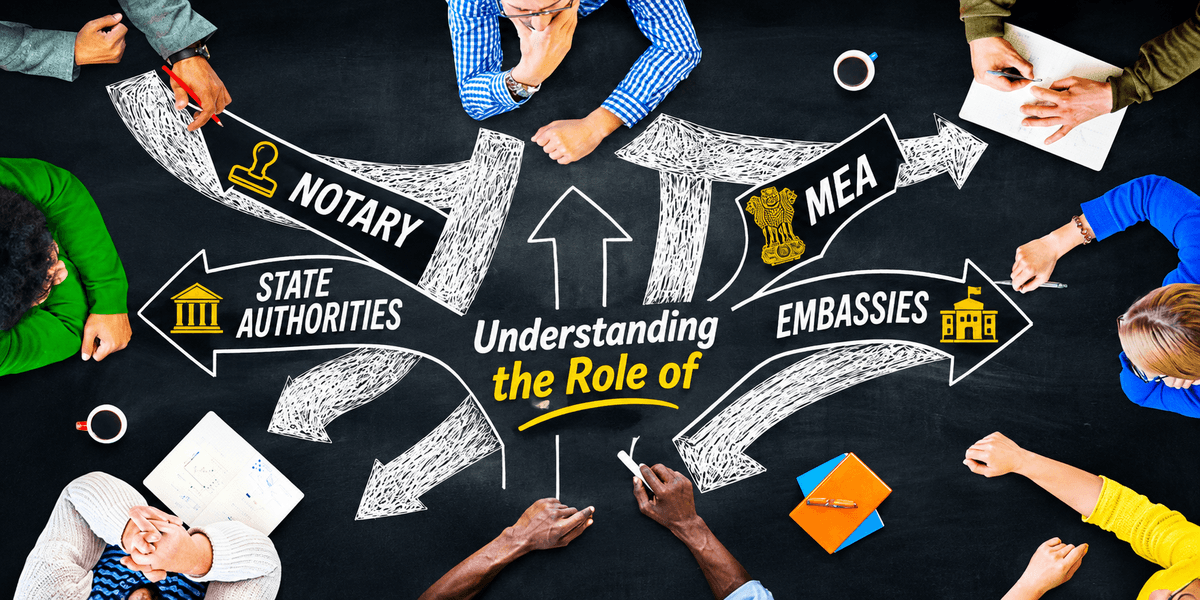
How to Get Documents Attested for Use Abroad – India Guide
If you are planning to work, study, relocate, sponsor a family member, establish a business, or complete legal formalities in another country, you may be asked to submit officially authenticated Indian documents. A degree certificate, birth certificate, marriage certificate, police clearance certificate, or commercial document may need to undergo a formal verification process before a foreign government department, employer, university, or other institution accepts it.
This process is commonly known as document attestation.
For Indian applicants, getting documents attested for use abroad can involve several authorities. Depending on the document and destination country, the process may include verification by the issuing university or state department, authentication by the Ministry of External Affairs (MEA), an apostille certificate, and embassy or consular legalization. Some countries may also require a final attestation by their Ministry of Foreign Affairs (MOFA).
The challenge is that there is no single procedure for every country or certificate. A degree certificate required for employment in the UAE may follow a different route from a birth certificate needed for a family visa in Qatar. Likewise, documents for Australia or a European country may qualify for apostille, while other destinations may require normal embassy attestation.
This guide explains how to get documents attested for use in a foreign country, which authorities are involved, what documents you may need, how to choose the correct authentication route, and how to avoid delays. It is written for Indian students, professionals, families, business owners, and anyone preparing documents for international use.
1. What Does It Mean to Get Documents Attested for Use Abroad?
Document attestation is the process of authenticating an official document so that it can be presented to an authority in another country. It generally verifies the signature, seal, stamp, or official capacity associated with the document.
When an Indian certificate is submitted abroad, the receiving institution may not be familiar with the issuing university, municipal office, government department, or business authority. Authentication provides a formal verification trail that helps the receiving authority assess the document's origin.
For example, an Indian professional moving to Dubai may be asked to submit an attested degree certificate to an employer. The document may need verification by the appropriate Indian authority, followed by the applicable MEA and UAE authentication procedures.
Similarly, an Indian couple applying for a family residence visa in Qatar may need to submit an attested marriage certificate. The process will depend on the issuing authority and the current requirements of the receiving Qatari authority.
In simple terms: Getting documents attested for use in a foreign country means completing the authentication procedure required by the destination country so that an Indian document can be submitted for an overseas purpose.
Attestation should not be confused with a guarantee that every statement in a document is factually correct or that a visa, job, admission, or application will be approved. Authentication establishes the relevant official origin or signature according to the applicable procedure. The receiving authority remains responsible for deciding whether the document meets its requirements.
2. Why Do Foreign Countries Require Document Attestation?
Foreign governments, employers, universities, immigration departments, and other institutions need reliable ways to assess official documents issued in other countries.
Document attestation helps reduce uncertainty about the origin and official status of a document. It also provides a recognized process for verifying signatures and seals across international jurisdictions.
The reasons for document attestation usually fall into the following categories.
Overseas Employment
Employers in foreign countries may request authenticated educational and professional certificates before completing recruitment or employment formalities.
For example, an Indian engineer applying for a position in Saudi Arabia may need to submit an authenticated engineering degree. A nurse applying for a healthcare job in Qatar may be asked for verified nursing qualifications and other professional records.
Common employment-related documents include:
- Degree certificates
- Diploma certificates
- Academic transcripts
- Professional qualifications
- Experience certificates
- Police clearance certificates
- Medical certificates, where required
Higher Education Abroad
International universities may request authenticated academic documents to assess an applicant's qualifications.
Students may need attestation or apostille for:
- Bachelor's degree certificates
- Master's degree certificates
- School certificates
- Academic transcripts
- Consolidated marksheets
- Diploma certificates
- Transfer certificates
- Provisional degree certificates
The university's admission instructions should determine which documents need authentication and which format is accepted.
Family and Dependent Visas
Family visa applications often require official proof of relationships.
For instance, a marriage certificate may be required when an employee sponsors a spouse, while a birth certificate may be requested for a child's dependent visa.
Depending on the destination country, these documents may need state-level verification, MEA authentication, embassy attestation, or apostille.
Immigration and Permanent Residency
Immigration applications may require authenticated civil, educational, professional, or police documents. Requirements vary by immigration program and applicant category.
International Business
Businesses expanding into foreign markets may need to authenticate company registration records, board resolutions, powers of attorney, commercial invoices, certificates of origin, and other documents.
Legal and Personal Matters
Affidavits, powers of attorney, divorce certificates, death certificates, and other legal documents may require authentication before they can be used in another country.
3. Step One: Identify the Destination Country and Purpose
The first and most important step is to identify where the document will be used and why it is required.
Do not begin by selecting an attestation package or submitting documents to an agency. Start with the instructions provided by the foreign employer, university, embassy, immigration authority, court, or other receiving organization.
The destination country determines which authentication route may apply. The purpose determines which documents and supporting records may be required.
For example:
| Purpose | Possible documents |
|---|---|
| Overseas employment | Degree, diploma, experience and PCC |
| Higher education | Degree, transcripts, marksheets and school certificates |
| Spouse visa | Marriage certificate and supporting identity records |
| Child dependent visa | Birth certificate and parent identity records |
| Permanent residency | PCC, birth certificate, marriage certificate and qualifications |
| Business expansion | Incorporation certificate, board resolution and power of attorney |
| International legal matters | Affidavit, power of attorney and court documents |
Ask the Receiving Authority These Questions
Before arranging document attestation, clarify:
- Does the authority require an original certificate or a certified copy?
- Is an apostille accepted?
- Is normal MEA attestation required?
- Is embassy or consular attestation necessary?
- Is further MOFA attestation required after arrival?
- Does the document need to be translated?
- Is there a specific validity period for the document?
- Are there additional requirements for documents issued by private universities or local authorities?
These questions can prevent unnecessary authentication and avoid choosing the wrong process.
4. Step Two: Identify the Type of Document
The next step is to classify the document. Indian documents are commonly grouped into three broad categories for attestation purposes: educational, personal, and commercial.
Each category may follow a different verification route.
A. Educational Documents
Educational certificate attestation is commonly required for overseas employment, professional registration, further education, and academic verification.
Examples include:
- Bachelor's degree certificates
- Master's degree certificates
- PhD certificates
- Engineering degrees
- Medical and nursing qualifications
- Diploma certificates
- Polytechnic certificates
- B.Ed. certificates
- School leaving certificates
- Secondary and higher secondary certificates
- Academic transcripts
- Consolidated marksheets
- Provisional degree certificates
Educational certificates may require verification by the issuing university, board, or designated state education authority before MEA attestation or apostille.
Applicants should confirm whether the receiving authority requires the original degree, transcript, marksheet, or a complete academic document set.
B. Personal Documents
Personal document attestation is often required for immigration, family sponsorship, marriage registration, and legal procedures.
Examples include:
- Birth certificates
- Marriage certificates
- Divorce certificates
- Death certificates
- Police clearance certificates
- Affidavits
- Single status certificates
- Name change affidavits
- Medical certificates
- Powers of attorney
- Adoption documents
- Family relationship certificates
The issuing authority matters. A birth certificate issued by a municipal corporation may follow a different verification procedure from an affidavit signed before a notary.
C. Commercial Documents
Commercial document attestation is relevant to companies and individuals conducting international business.
Examples include:
- Certificate of incorporation
- Memorandum of Association
- Articles of Association
- Board resolutions
- Commercial invoices
- Certificates of origin
- Business agreements
- Partnership deeds
- Company authorization letters
- Powers of attorney
- Export-related certificates
- Business registration records
Commercial documents may require pre-authentication by a recognized chamber of commerce or another designated authority before the relevant government authentication stage.
5. Step Three: Check Whether the Document Needs Preliminary Verification
Before MEA attestation or apostille, some documents need to be authenticated by the authority responsible for the issuing institution or document category.
This is often referred to as preliminary verification or state-level authentication.
The correct authority depends on the document.
Educational Certificate Verification
Educational certificates may need verification by:
- The issuing university
- The relevant educational board
- A designated state education department
- Another authority recognized under the applicable procedure
For example, a degree certificate issued by a university in Karnataka may need to follow the verification procedure applicable to that university or the designated state authority.
A certificate issued by a university in another state may need to follow that state's procedure, even if the applicant currently lives in Bengaluru.
Personal Document Verification
Personal certificates may require authentication by the relevant issuing authority or state department.
Examples include:
- Birth certificates issued by municipal corporations
- Marriage certificates issued by a marriage registrar
- Death certificates issued by local authorities
- Affidavits prepared through a notary or other legally authorized process
The appropriate state Home Department, General Administration Department, or other designated authority may be involved depending on the document.
Commercial Document Verification
Commercial certificates may require pre-authentication by a chamber of commerce or another recognized business authority.
The applicable process depends on the nature of the document and the destination country.
Why Preliminary Verification Matters
MEA authentication is generally based on the recognized signature or authentication of the designated authority. It is not a substitute for every underlying verification requirement.
Submitting a certificate without the required preliminary authentication may lead to delays or rejection.
6. Step Four: Decide Between Apostille and Normal Attestation
One of the most important decisions is whether the document needs an apostille or normal attestation.
These are two different forms of authentication.
What Is an Apostille?
An apostille is a certificate issued under the Hague Apostille Convention framework. It authenticates the origin of a public document for use in another country where the Convention applies between the relevant states.
India is a member of the Hague Apostille Convention, and the Ministry of External Affairs is India's designated competent authority for issuing apostilles.
An apostille generally confirms:
- The authenticity of the signature on the document
- The capacity in which the person signing acted
- The identity of the seal or stamp on the document
It does not automatically verify every statement in the document or guarantee acceptance for every purpose.
Apostille may be relevant for:
- Birth certificates
- Marriage certificates
- Death certificates
- Educational certificates
- Affidavits
- Powers of attorney
- Other eligible public documents
What Is Normal Attestation?
Normal MEA attestation is used for countries where apostille is not applicable or accepted for the intended use.
Depending on the destination country's requirements, the process may continue through its embassy or consulate in India and may involve further authentication after the document reaches that country.
How to Choose the Correct Route
Use this general decision process:
- If the destination and document qualify under the Hague Apostille Convention: Check whether the receiving authority requires an apostille.
- If the destination does not accept apostille for the intended use: Confirm whether normal MEA attestation and embassy or consular legalization are required.
- If the receiving authority has a special procedure: Follow its specific instructions, even if a general country guide describes a different route.
Do not assume that every European country automatically requires only an apostille or that every Gulf country follows exactly the same embassy procedure. Check the current requirements for the specific destination and document.
7. Step Five: Apply for MEA Attestation or Apostille
The Ministry of External Affairs is India's central authority for apostille and normal attestation of eligible documents intended for use abroad.
Applicants generally need to ensure that the document has completed the required preliminary verification before it is submitted through the applicable MEA channel.
What Is the e-Sanad Portal?
e-Sanad is an online initiative of the Ministry of External Affairs for document verification and attestation or apostille.
It is designed to support a contactless, faceless, cashless, and paperless process where the document and issuing authority are supported by the system.
The portal's availability depends on the digital records and issuing authorities integrated into the system. Therefore, not every document can necessarily be processed online.
General e-Sanad Application Steps
For an eligible document, the process may involve:
- Registering on the e-Sanad portal.
- Selecting the appropriate document and issuing authority.
- Uploading the required document or accessing the relevant digital record.
- Completing the application details.
- Paying the applicable charges.
- Allowing the document to undergo verification.
- Receiving the result through the available digital process.
Follow the portal's current instructions because supported document types and procedures may change.
What If Your Document Is Not Available Through e-Sanad?
Some documents may need to follow the applicable offline procedure through designated channels and authorized service providers.
The MEA process and submission arrangements can vary according to the document and location. Confirm the current submission instructions before handing over original documents.
8. Step Six: Complete Embassy or Consular Attestation If Required
If the destination country requires embassy or consular attestation, the next stage may involve the relevant foreign diplomatic mission in India.
Embassy attestation is not automatically required for every country or every document. It depends on the destination country's legal framework and the receiving authority's instructions.
The embassy or consulate may have specific requirements for:
- Document category
- Prior state verification
- MEA authentication
- Application forms
- Supporting identity documents
- Fees
- Submission appointments
- Physical or digital document format
What Happens During Embassy Attestation?
The embassy or consulate performs the authentication service available under its rules. The process may verify the relevant official signature, seal, or previous authentication.
The embassy does not necessarily verify the complete factual contents of every document.
Applicants should use the official requirements of the relevant mission to confirm whether the document is eligible and which prior steps are necessary.
9. Step Seven: Arrange MOFA Attestation Where Required
MOFA stands for Ministry of Foreign Affairs. Some countries require documents to undergo a further authentication process through their own Ministry of Foreign Affairs or an equivalent authority.
This may happen after Indian-side authentication and any required embassy process.
For example, certain UAE document attestation procedures can include authentication by the UAE Embassy in India and UAE MOFA.
The UAE also offers a digital attestation service for eligible Indian-issued documents through its embassy in New Delhi. The official procedure requires the original physical document and provides a combined service covering the UAE Embassy and UAE MOFA stages.
However, this is a country-specific process. Applicants should not assume that the same procedure applies to Qatar, Kuwait, Bahrain, Oman, or Saudi Arabia.
Is MOFA Attestation Required for Every Country?
No. MOFA attestation is a destination-country requirement and is not a universal stage in international document authentication.
Confirm whether the receiving authority requires it before arranging the service.
10. Step Eight: Arrange Certified Translation If Needed
Some countries and institutions require documents to be submitted in a language other than English.
Translation requirements vary by destination and receiving authority.
The authority may specify:
- A certified translator
- A sworn translator
- An embassy-recognized translator
- A translation completed before attestation
- A translation completed after authentication
The order of translation and attestation is important. In some cases, the original document must be authenticated first and the translation handled separately. In other cases, the translation itself may need notarization or authentication.
Before arranging translation, confirm:
- Which language is accepted?
- Must the translation be certified?
- Is a sworn translator required?
- Must the translator's signature be authenticated?
- Should the translation be completed before or after apostille or embassy attestation?
- Do not rely on an ordinary translation if the receiving authority specifically requires a certified or sworn translation.
11. Country-Wise Document Attestation Guidance
The authentication route depends on the destination country, document type, and intended purpose. The following overview introduces common destination groups for Indian applicants. It is a planning guide, not a substitute for current instructions from the receiving authority.
UAE and Dubai
Indian applicants moving to the UAE for employment, family sponsorship, education, or business may need authenticated educational, personal, or commercial documents.
Common documents include:
- Degree and diploma certificates
- Birth certificates
- Marriage certificates
- Commercial documents
- Powers of attorney
- Other eligible official records
Depending on the document and current rules, Indian-side authentication and UAE-side attestation may be required.
Dubai is an emirate within the UAE, so applicants should check the relevant UAE procedure rather than treating Dubai as a separate country.
Qatar
Qatar document attestation may be required for employment, family residence, education, and business purposes.
Degree certificates, marriage certificates, birth certificates, and commercial documents may follow different procedures. Confirm the required sequence with the receiving authority before submitting documents.
Kuwait
Indian professionals and families moving to Kuwait may need authenticated educational and civil certificates.
A degree certificate for employment and a marriage certificate for family sponsorship may have different verification requirements.
Bahrain
Bahrain may require authenticated educational, personal, and commercial documents for employment, family, or business matters.
Applicants should confirm the relevant Bahrain-side authentication requirements in addition to Indian-side verification.
Oman
Documents intended for use in Oman may require a country-specific attestation process. Educational, personal, and commercial documents should be assessed separately.
Saudi Arabia
Saudi Arabia has authentication requirements for various employment, family, professional, and commercial purposes. Indian applicants should confirm the current requirements for the specific certificate and visa category.
Malaysia and Singapore
Applicants planning to work, study, or conduct business in Malaysia or Singapore should check whether the receiving authority requires apostille, embassy authentication, or another form of document verification.
Australia
Indian documents intended for Australia may require apostille or another accepted authentication process, depending on the destination authority and purpose.
Vietnam
Documents for use in Vietnam may require a legalization process. Confirm the applicable Indian-side and Vietnamese-side steps before submission.
European Countries
Many European destinations participate in the Hague Apostille Convention. Where the Convention applies between the relevant countries and the document is eligible, an apostille may be appropriate.
Additional requirements, including translation, may still apply.
African Countries
Requirements differ across African destinations. Some countries accept apostilles under the applicable Convention framework, while others may require normal attestation or embassy legalization.
North American Countries
The United States, Canada, and Mexico have their own document authentication requirements. Applicants should check the procedure applicable to the specific country and intended use rather than assuming a single North American process.
12. Documents Commonly Required for Attestation
The exact requirements depend on the document and destination country. However, applicants may be asked to provide some of the following:
- Original certificate or document
- Clear photocopy of the certificate
- Passport copy of the document holder
- Application form, where required
- Applicant contact information
- Supporting verification records
- Authorization letter, if a representative submits documents
- Certified translation, if required
- Previous authentication records, where applicable
Additional Requirements for Educational Documents
Applicants may need:
- University verification
- Academic transcripts
- Marksheets
- Degree completion records
- Enrollment or registration details
Additional Requirements for Personal Documents
Applicants may need:
- Civil registration details
- Supporting identity records
- Marriage or relationship records
- Issuing authority verification
Additional Requirements for Commercial Documents
Companies may need:
- Certificate of incorporation
- Board resolution
- Authorized signatory details
- Chamber of commerce verification
- Company registration records
- Supporting commercial paperwork
Prepare the complete document set before starting the process. Missing supporting records can create avoidable delays.
13. How Much Does Document Attestation Cost?
There is no single price for getting documents attested for use in every foreign country.
The total cost depends on the document type, destination, authentication route, number of documents, government charges, embassy fees, translation, and service-provider charges.
Common cost factors include:
Document Category
Educational, personal, and commercial certificates may require different verification stages.
Destination Country
Each country may have different embassy, consular, and MOFA requirements.
Preliminary Verification
University, state department, municipal authority, or chamber of commerce verification may involve additional charges.
MEA and Embassy Fees
Government and diplomatic mission charges depend on the service and current fee schedule.
Translation
Certified or sworn translation may increase the total cost.
Collection and Delivery
Pickup, courier, and return delivery charges may apply.
How to Avoid Unexpected Charges
Request a written quotation that clearly separates:
- Government fees
- Embassy or consular fees
- Preliminary verification charges
- Service-provider fees
- Translation costs
- Pickup and delivery charges
- Any optional or additional services
Compare the complete process and service scope rather than choosing a provider only because it advertises a low starting price.
14. How Long Does It Take to Get Documents Attested?
Processing time depends on the issuing authority, destination country, document category, and required authentication stages.
A document that is already available in a supported digital repository may follow a different timeline from one that needs manual verification by a university or state department.
Potential causes of delay include:
- University verification
- State-level authentication
- Incomplete documents
- Differences in personal details
- Embassy appointment availability
- Public holidays
- Translation requirements
- Courier delays
- Changes in government procedures
The MEA Citizen's Charter publishes service information and indicative timelines for its services. Applicants should check the current published timeline and remember that the complete end-to-end process can take longer when preliminary or destination-country stages are involved.
Start the process well before your visa appointment, employment joining date, university deadline, or business transaction.
15. Common Mistakes to Avoid When Getting Documents Attested
Even a genuine certificate may face delays if the applicant selects the wrong authentication route or submits incomplete records.
Mistake 1: Choosing Apostille Without Checking Eligibility
An apostille is not automatically suitable for every country or document. Confirm whether the Convention applies and whether the receiving authority requires an apostille.
Mistake 2: Assuming Every Country Requires Embassy Attestation
Some destinations accept apostilles for eligible documents. Embassy attestation should not be arranged unless it is required.
Mistake 3: Ignoring Preliminary Verification
Some certificates must be authenticated by a university, state department, or other designated authority before MEA processing.
Mistake 4: Submitting Incorrect Documents
A receiving authority may require the original certificate, a particular copy format, or supporting records. Confirm the required format.
Mistake 5: Overlooking Name Differences
Differences between passport details, degree certificates, birth records, and marriage certificates can create verification issues.
Mistake 6: Assuming Notarization Is Enough
A notary's signature does not automatically replace state authentication, MEA attestation, apostille, or embassy legalization.
Mistake 7: Ignoring Translation Requirements
A document may need a certified or sworn translation. Confirm the language and certification rules before arranging translation.
Mistake 8: Starting Too Late
University verification, state procedures, and embassy processing can take time. Start early and allow room for corrections.
Mistake 9: Choosing a Provider Without Understanding Its Role
A private agency may coordinate document collection and submission, but it is not the government authority that issues an apostille or performs official attestation.
16. How to Choose a Reliable Document Attestation Service Provider
A professional document attestation service provider can help applicants coordinate a complicated process, particularly when several authorities are involved.
However, applicants should evaluate the provider carefully before submitting original certificates.
Experience With the Destination Country
Choose a provider familiar with the specific country and document category. Experience with UAE degree attestation does not automatically mean the provider has the same expertise in Vietnam commercial legalization or European apostille procedures.
Clear Process Explanation
The provider should explain the expected authentication stages, documents required, submission method, and possible reasons for delay.
Transparent Pricing
Request a written quotation with government fees, service charges, translation, and delivery costs clearly explained.
Secure Document Handling
Ask how original documents are collected, stored, transported, and returned. Obtain an acknowledgment or receipt.
Application Updates
A professional provider should offer a practical way to check the progress of the application.
No Unsupported Guarantees
Be cautious of promises of guaranteed visa approval, instant government attestation, or special access to officials without verifiable evidence.
Written Service Terms
Review refund policies, cancellation terms, service limitations, and responsibilities for courier handling before making payment.
17. Can You Get Documents Attested From a Different City in India?
In many cases, applicants can coordinate the attestation process while living in a city different from the place where the document was issued.
However, the relevant verification route may still depend on the issuing university, municipal corporation, state department, or other authority.
For example, an applicant living in Bengaluru with a degree from a university in Kerala may need to follow the verification procedure applicable to that university or the relevant Kerala authority.
Similarly, a birth certificate issued in Maharashtra may need to follow the applicable process for that issuing authority.
Before submitting the document, confirm:
- Where the document was issued
- Which authority is responsible for verification
- Whether the original is required
- Whether physical submission is necessary
- Whether a representative can submit the document
- Whether an authorized service provider can coordinate the process
Your current residence does not necessarily determine the verification authority for a certificate issued elsewhere.
18. Can You Get Documents Attested Without Visiting Government Offices?
Some applicants can use official online channels or authorized service providers rather than personally visiting every government office.
For eligible documents, e-Sanad offers an online route for document verification and authentication. Other procedures may require physical submission through designated channels.
A private service provider may assist with:
- Document collection
- Application preparation
- Submission coordination
- Status updates
- Courier arrangements
- Return delivery
However, assistance with the process is different from performing the official authentication. The relevant government or diplomatic authority remains responsible for the official attestation or apostille.
Before using a remote service, confirm whether original documents are required, how they will be handled, and how they will be returned.
19. What Should You Do If Your Document Is Rejected?
A returned or rejected document does not always mean that the certificate is invalid. It may indicate that a procedural requirement has not been met.
If your document is rejected:
Ask for the specific reason for rejection.
Check whether the issue relates to the certificate, issuing authority, application, or authentication route.
Confirm whether additional verification is required.
Correct errors through the issuing authority where necessary.
Obtain clarification from the relevant government or diplomatic authority.
Resubmit only after confirming the correct procedure.
Never alter an official certificate yourself. If a spelling or date error exists, follow the issuing authority's formal correction procedure.
20. Final Checklist Before Submitting Documents for Foreign Use
Use this checklist before starting your application.
Destination and Purpose
- Identify the country where the document will be used.
- Confirm the purpose: employment, education, immigration, family visa, or business.
- Obtain written instructions from the receiving authority.
- Confirm whether apostille or normal attestation is required.
Document Preparation
- Check that the original certificate is available.
- Verify names and personal details.
- Ensure that the document is complete and readable.
- Identify the issuing authority.
- Confirm whether preliminary verification is necessary.
- Check whether translation is required.
Authentication
- Confirm the applicable state or institutional verification.
- Check the MEA process.
- Confirm whether embassy or consular attestation is required.
- Check whether destination-country MOFA attestation is needed.
- Follow the official submission instructions.
Service Provider and Delivery
- Request a complete quotation.
- Understand the service provider's responsibilities.
- Confirm document collection and return arrangements.
- Obtain a submission receipt.
- Keep copies of supporting documents.
Final Review
- Check that the correct certificate has been returned.
- Review all authentication details.
- Confirm that any required translation is included.
- Follow the receiving authority's submission instructions.
Frequently Asked Questions About Getting Documents Attested for Use Abroad
1. How can I get my documents attested for use in a foreign country?
First, identify the destination country and the purpose of the document. Check whether the receiving authority requires apostille or normal attestation. Complete the necessary preliminary verification, then follow the applicable MEA, embassy, or consular process. Some countries may also require MOFA attestation.
2. Where can I get documents attested in India?
Eligible Indian documents can be processed through the applicable Ministry of External Affairs channels, including e-Sanad where supported. Preliminary verification may need to be completed by the relevant state department, university, educational board, or commercial authority.
3. Is MEA attestation compulsory for every foreign country?
The required procedure varies by destination and document type. Some documents require MEA apostille, while others need normal MEA attestation and possibly embassy legalization. Follow the receiving authority's current instructions.
4. What is the difference between apostille and embassy attestation?
Apostille is an authentication certificate under the Hague Apostille Convention. Embassy attestation is a separate diplomatic authentication process used when required by the destination country. The correct route depends on the destination and intended use.
5. Which documents can be attested for overseas use?
Common examples include degree certificates, diplomas, marksheets, birth certificates, marriage certificates, death certificates, police clearance certificates, affidavits, powers of attorney, company records, commercial invoices, and certificates of origin. Eligibility and procedure depend on the relevant authority.
6. Can I get my degree certificate attested for overseas employment?
Yes. Eligible degree certificates can undergo the applicable verification and authentication process. This may involve university or state verification followed by MEA attestation or apostille and any additional destination-country requirements.
7. How can I get my birth certificate attested for a foreign family visa?
Check the receiving country's requirements first. The process may involve verification by the issuing municipal or civil registration authority, followed by the applicable MEA and destination-country authentication steps.
8. Do marriage certificates need attestation for spouse visas?
Many foreign authorities request authenticated marriage certificates for spouse or family visa applications. The precise requirements depend on the destination country and the authority processing the application.
9. Can I get a police clearance certificate attested?
An eligible police clearance certificate may require apostille or normal attestation for overseas immigration or employment. Check the issuing authority and destination-country instructions before applying.
10. How long does document attestation take?
The timeline varies according to the certificate, issuing authority, destination, and number of authentication stages. Preliminary verification and embassy processing can extend the total time. Check the current estimates from each relevant authority.
11. What is the cost of document attestation in India?
The total cost depends on government fees, preliminary verification, embassy charges, service-provider fees, translation, and courier services. Request a complete quotation before submitting your documents.
12. Can I get documents attested online?
Some eligible documents can be processed through e-Sanad, the MEA's online verification and attestation initiative. Other documents may require physical submission or additional verification.
13. Can I use a notarized copy instead of the original certificate?
Only if the receiving authority and the relevant authentication procedure accept that format. Notarization does not automatically replace the required apostille, MEA, or embassy process.
14. Is MOFA attestation necessary after embassy attestation?
It depends on the destination country and document type. Some countries require a final authentication by their Ministry of Foreign Affairs, while others do not.
15. Can I get documents attested if I live in another Indian state?
You may be able to coordinate the process from your current city. However, preliminary verification may still need to follow the procedure of the state or institution that issued the document.
16. Do I need to translate my documents before attestation?
Not always. Translation requirements depend on the receiving authority. Some require certified or sworn translations, and the correct timing of translation may vary.
17. Does apostille guarantee that my foreign visa will be approved?
No. Apostille authenticates the origin of an eligible public document under the Convention framework. Visa approval depends on the complete application and the relevant immigration rules.
18. Can commercial documents be attested for international business?
Yes. Eligible commercial documents may require authentication for exports, company registration, business representation, and international transactions. The process depends on the document and destination.
19. How do I choose a reliable document attestation agency?
Check the agency's country-specific experience, written process explanation, pricing transparency, document security, tracking arrangements, and service terms. Avoid unsupported guarantees of instant attestation or visa approval.
20. What should I do if my document is rejected?
Ask for the exact reason, identify the missing requirement, contact the issuing authority if a correction is needed, and confirm the correct authentication route before resubmitting the document.
Getting documents attested for use in a foreign country is an important part of preparing for overseas employment, education, immigration, family sponsorship, legal matters, and international business.
The process begins with identifying the destination country and understanding what the receiving authority expects. You then need to classify your document, confirm the issuing authority, complete any required preliminary verification, and select the correct authentication route.
For eligible documents, the process may involve an MEA apostille. For other destinations, normal MEA attestation and embassy or consular legalization may be required. Some countries also require further authentication through their Ministry of Foreign Affairs. Translation and supporting records may form additional parts of the application.
The most important rule is simple: never assume that one attestation procedure applies to every country or document. Confirm the current requirements for your exact certificate and intended use before submitting original documents.
Prepare your paperwork carefully, check personal details, allow enough processing time, and use a service provider that explains its responsibilities transparently. With the right preparation, you can reduce avoidable delays and make your international documentation process easier to manage.

- All
- Apostille
- Attestation
- Australia Apostille
- Austria Apostille
- Bahrain Attestation
- China Attestation
- Egypt Attestation
- Embassy
- France Apostille
- Germany Apostille
- HRD
- Italy Apostille
- Kuwait Attestation
- Lithuania Apostille
- MEA
- Malaysia Attestation
- Mexico Apostille
- Netherlands Apostille
- Nigeria Attestation
- Oman Apostille
- PCC
- Philippines Attestation
- Qatar Attestation
- Saudi Arabia Attestation
- Taiwan Attestation
- Translation
- UAE Attestation
- UK Apostille
- USA Apostille
- Vietnam Attestation
- Visa
- Visa Stamping